
A factory, not a desk.
There is a screenshot of my n8n workflow that I love more than any photo of my workspace. It looks like a factory floor: little boxes connected by little wires, messages flowing from one station to the next, no people anywhere.

This is my factory floor
That is the point. The best work I do now happens when I am asleep.
From doing to designing
For a year I did everything by hand. I asked AI for help, read the answer, clicked the buttons myself — post the article, post the video, check the price, write the email. I was the worker and the machine was my advisor.
Then an engineer thought occurred to me, the kind I had spent 35 years having at construction sites: stop pushing the material yourself. Build the conveyor belt.
In construction you don’t carry every brick. You design the structure so that gravity, concrete and steel do the work for you. Software is the same. I stopped doing tasks and started building systems that do tasks.
The stack
Today a small machine park runs on a rented computer — a VPS that never sleeps — and it works like this:
The trend hunter wakes every six hours, scans what’s hot, and taps me on the shoulder on Telegram: look at this.

The trend hunter, checking what’s hot
The deal scanner runs once a day at 8 a.m., filters real bargains, and writes a draft article straight into the website.
The editor drafts the post, then asks me — one tap on Telegram — approve or reject. I kept that one human finger on the switch on purpose.
The marketer cuts the articles into short videos and posts them to five channels.
The secretary answers routine emails and writes the morning report of what the machines did while I slept.
Each one is dumb on its own. A workflow is just boxes and wires. But wired together, they are a factory with no closing hours.
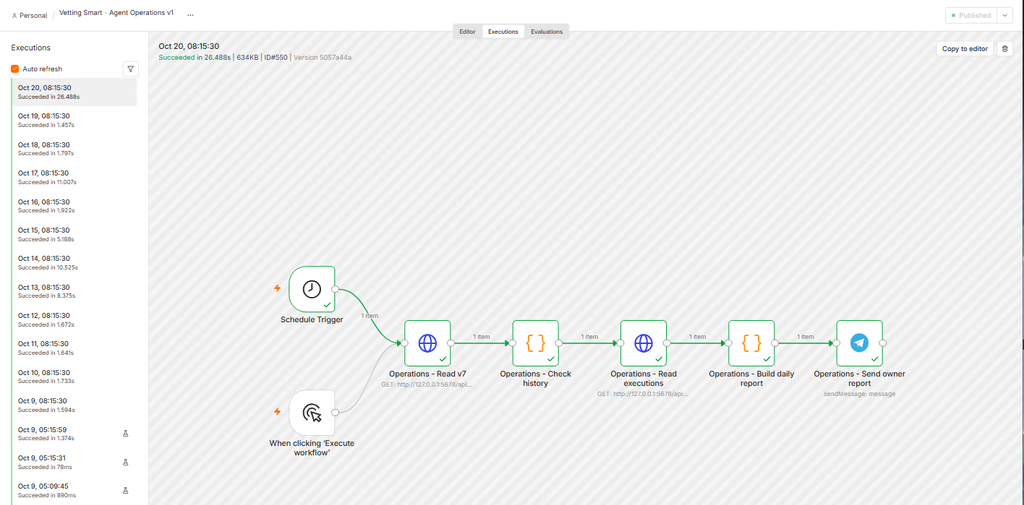
The morning report, built by machines
The engineer’s shift
What changed wasn’t the software. It was me.
On a construction site, the foreman who insists on laying every brick himself is a bad foreman. His job is to make sure the structure stands when he leaves the site. My machines are my structure now. I design the workflow the way I once designed a floor slab: define the load, pick the materials, check the failure points — then walk away and trust it.
This is also why the trading robot is not allowed to be “helped.” It runs on its own VPS, untouched, forward-testing in real time. If I reached in and closed a trade by hand, the whole experiment would be contaminated. The machine either works or it doesn’t. My hands are not part of the test.
Honest machines, honest results
Let me say the unglamorous part out loud, because nobody in the automation space says it: my machines don’t print money. They print drafts, alerts, reports and videos. They save me hours. They do not deposit a single dollar.
The affiliate sites run on a kill criterion I set myself: one year to earn its own keep, or they die — I only lose my time. The EA runs a forward test with no promises attached. The factory is real. The profits are not yet.
And that is fine. An engineer doesn’t declare a bridge finished because the scaffolding looks beautiful. You declare it finished when the load tests pass.
What the factory gave me
Somewhere along the way I stopped feeling like a man racing against the clock. The trend hunter scans at 4 a.m. while I sleep. The morning report waits for me when I wake up. I work from 1 a.m. to late afternoon, but the factory works the other shift — the one where I am not there.
I spent 35 years building structures that outlast their builder. Bridges, buildings, roads. Now I build machines that outlast my workday.
The desk was me. The factory is mine.
Your turn — I read every comment:
1. What’s the one repetitive task you wish a machine would take off your plate?
2. Have you ever built something that kept working while you slept? What was it?
3. Would you trust a machine with the boring half of your job — or check its work forever?
Tell me below. The best questions become material for the next parts.
Next: I Built a Website for $2 (None of It Mine) — a $5 gift, a $2 sale, and a site that cost me nothing but questions.
Leave a Reply