Author: admin

  • I Built a Website for $2 (None of It Mine)

    A $5 gift, a $2 sale, and a site that cost me nothing but questions.

    The website you will never have to pay to visit cost me two dollars. Neither of them was mine.

    The $5 gift

    Vantage — the broker where I run my trading experiments — sent me a $5 Visa gift card. A promotion, a thank-you, whatever it was. Most people would have spent it on coffee.

    I spent it on a website.

    The $2 sale

    IONOS was running a sale. Twelve months of hosting for $1. Domain Guard for $1. The domain itself — free for the first year. Two dollars total. I typed in the gift card number and watched the confirmation screen load.

    Total from my own pocket: zero.

    “The actual receipt. Two dollars, itemized.”

    The AI built the rest

    Here is the part that still feels strange to write. The website — shopdealai.com — every page, the deal boxes, the contact form, the privacy policy — was built by artificial intelligence. I asked. It wrote. I pointed. It deployed.

    “shopdealai.com — the $2 website, live.”

    The social channels followed. Then the deal engine: a small machine that finds discounted products and puts them in front of people who like a bargain. Built out of questions, the same way everything else I own was built.

    No referral links in this story

    Let me say this plainly, because it was a deliberate choice: there are no referral links in this article. Not for the broker, not for the hosting company.

    In trading content, a referral link reads as a funnel. And I have spent this entire series trying to be the one voice that doesn’t funnel you anywhere. Referral links belong on the deal site itself, disclosed upfront — not smuggled into a story about learning.

    So this part has nothing to click. That is the point.

    Not to get rich

    I didn’t build the site to get rich. I built it because a retired engineer with a computer is a dangerous thing to leave unsupervised — and because it is genuinely fun to own a machine that works while I sleep.

    $2 total, none of it mine

    That is the honest promo-year math, and it holds up. But every “$2 startup” story owes you the real invoice — what the renewals actually cost, what the other servers run, and what a year of 2 a.m. sessions was really worth. That comes next.

    Your turn — I read every comment

    1. What’s the cheapest thing you ever built that turned out to be worth real joy?
    2. If someone handed you $2, what would you choose — one cup of coffee, or a whole new job: building a website?
    3. Would you trust an AI to build your website end to end — or keep a hand on every page?

    The best questions become material for the next parts.

    Next: What It Actually Cost — the honest ledger.
  • Ken Griffin Characterizes AI Market as Probable Bubble and Warns of Potential GPU Price Collapse

    Ken Griffin Characterizes AI Market as Probable Bubble and Warns of Potential GPU Price Collapse
    Original illustration by Vetting Smart.

    Confirmed Facts

    Citadel founder Ken Griffin has stated that the artificial intelligence sector is “almost certainly” in a bubble. He cautioned that a potential chip glut could lead to a crash in prices, comparing the situation to the pricing dynamics of empty airline seats. Griffin noted that while a bubble may exist, the companies that survive the market correction are expected to lead for several decades.

    Possible Implications

    • If a chip glut occurs, the resulting price crash for GPUs could reduce operational costs for AI developers while simultaneously devaluing the hardware assets of current infrastructure providers.
    • A market correction might lead to a consolidation of power, where only a few resilient firms emerge as long-term leaders in the technology space.

    Source Limitations

    The provided excerpt does not offer specific quantitative data or financial metrics to support the characterization of a bubble. It fails to define a specific timeline for the predicted price crash or identify which hardware manufacturers are most susceptible to oversupply. Furthermore, the text does not name the specific firms Griffin anticipates will lead the industry in the coming decades.


    Source: Decrypt. Analysis based on the RSS excerpt.

    Read more on Vetting Smart Blog

    Published: 22/10/2026 – 10:00 (UTC)

  • Bitcoin Retraces to 82,500 USD Support Following Brief Surge Above 84,000 USD

    Bitcoin Retraces to 82,500 USD Support Following Brief Surge Above 84,000 USD
    Original illustration by Vetting Smart.

    Confirmed Facts

    Bitcoin surpassed the 84,000 USD price level late Wednesday before retracing to a support level of 82,500 USD. This price movement occurred as technology futures experienced a decline. The market performance is being closely monitored by analysts as tech sentiment remains volatile.

    Possible Implications

    If the 82,500 USD support level fails to hold, Bitcoin could experience further downward pressure in alignment with technology sector sentiment. The correlation with tech futures suggests that digital asset valuations may continue to be sensitive to broader macroeconomic and technology-driven market shifts.

    Source Limitations

    The provided excerpt does not specify the exact percentage drop in tech futures or the specific analysts monitoring the support levels. While the headline mentions Tesla, Meta, and AI nerves, the text does not provide specific data points, earnings figures, or detailed explanations regarding how these factors influenced the price action.


    Source: CoinDesk. Analysis based on the RSS excerpt.

    Read more on Vetting Smart Blog

    Published: 22/10/2026 – 04:01 (UTC)

  • I Built the Machine

    A factory, not a desk.

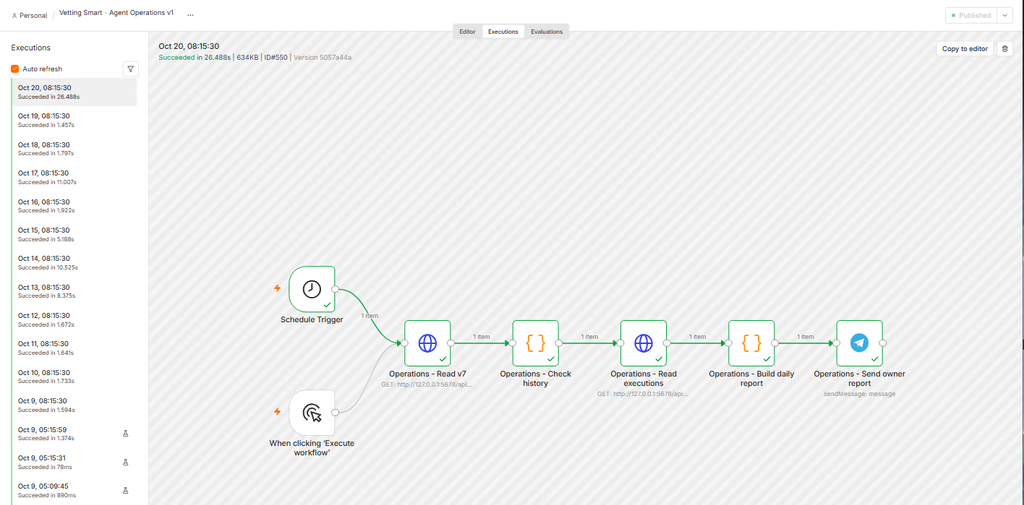
    There is a screenshot of my n8n workflow that I love more than any photo of my workspace. It looks like a factory floor: little boxes connected by little wires, messages flowing from one station to the next, no people anywhere.

    This is my factory floor

    That is the point. The best work I do now happens when I am asleep.

    From doing to designing

    For a year I did everything by hand. I asked AI for help, read the answer, clicked the buttons myself — post the article, post the video, check the price, write the email. I was the worker and the machine was my advisor.

    Then an engineer thought occurred to me, the kind I had spent 35 years having at construction sites: stop pushing the material yourself. Build the conveyor belt.

    In construction you don’t carry every brick. You design the structure so that gravity, concrete and steel do the work for you. Software is the same. I stopped doing tasks and started building systems that do tasks.

    The stack

    Today a small machine park runs on a rented computer — a VPS that never sleeps — and it works like this:

    The trend hunter wakes every six hours, scans what’s hot, and taps me on the shoulder on Telegram: look at this.

    The trend hunter, checking what’s hot

    The deal scanner runs once a day at 8 a.m., filters real bargains, and writes a draft article straight into the website.

    The editor drafts the post, then asks me — one tap on Telegram — approve or reject. I kept that one human finger on the switch on purpose.

    The marketer cuts the articles into short videos and posts them to five channels.

    The secretary answers routine emails and writes the morning report of what the machines did while I slept.

    Each one is dumb on its own. A workflow is just boxes and wires. But wired together, they are a factory with no closing hours.

    The morning report, built by machines

    The engineer’s shift

    What changed wasn’t the software. It was me.

    On a construction site, the foreman who insists on laying every brick himself is a bad foreman. His job is to make sure the structure stands when he leaves the site. My machines are my structure now. I design the workflow the way I once designed a floor slab: define the load, pick the materials, check the failure points — then walk away and trust it.

    This is also why the trading robot is not allowed to be “helped.” It runs on its own VPS, untouched, forward-testing in real time. If I reached in and closed a trade by hand, the whole experiment would be contaminated. The machine either works or it doesn’t. My hands are not part of the test.

    Honest machines, honest results

    Let me say the unglamorous part out loud, because nobody in the automation space says it: my machines don’t print money. They print drafts, alerts, reports and videos. They save me hours. They do not deposit a single dollar.

    The affiliate sites run on a kill criterion I set myself: one year to earn its own keep, or they die — I only lose my time. The EA runs a forward test with no promises attached. The factory is real. The profits are not yet.

    And that is fine. An engineer doesn’t declare a bridge finished because the scaffolding looks beautiful. You declare it finished when the load tests pass.

    What the factory gave me

    Somewhere along the way I stopped feeling like a man racing against the clock. The trend hunter scans at 4 a.m. while I sleep. The morning report waits for me when I wake up. I work from 1 a.m. to late afternoon, but the factory works the other shift — the one where I am not there.

    I spent 35 years building structures that outlast their builder. Bridges, buildings, roads. Now I build machines that outlast my workday.

    The desk was me. The factory is mine.

    Your turn — I read every comment:

    1. What’s the one repetitive task you wish a machine would take off your plate?

    2. Have you ever built something that kept working while you slept? What was it?

    3. Would you trust a machine with the boring half of your job — or check its work forever?

    Tell me below. The best questions become material for the next parts.

    Next: I Built a Website for $2 (None of It Mine) — a $5 gift, a $2 sale, and a site that cost me nothing but questions.

  • Musk Describes Tesla-SpaceX Merger as Good Idea Following Ninefold AI Revenue Growth

    Musk Describes Tesla-SpaceX Merger as Good Idea Following Ninefold AI Revenue Growth
    Original illustration by Vetting Smart.

    Confirmed Facts

    Elon Musk has characterized a potential merger between Tesla and SpaceX as a “good idea.” This statement coincides with reports that revenue related to artificial intelligence (AI) has increased ninefold. If executed, the merger would bring Tesla into the same corporate group as SpaceXAI, the developer of the Grok AI model, and the social media platform X.

    Possible Implications

    Such a merger could lead to a centralized corporate structure, potentially streamlining the integration of Grok’s AI capabilities with Tesla’s hardware and automotive systems. A ninefold jump in AI revenue suggests that Musk’s AI ventures are scaling rapidly, which could influence the valuation of his public and private entities if consolidated. This move might indicate a strategic shift toward unified resource management across his social media, aerospace, and electric vehicle companies.

    Source Limitations

    The provided excerpt does not specify the exact dollar figures behind the ninefold revenue growth or the specific timeframe for this increase. It fails to clarify the legal or structural relationship between SpaceX and the entity referred to as “SpaceXAI.” Furthermore, the text does not outline a formal timeline for a merger or provide details on the regulatory hurdles associated with combining a publicly traded firm like Tesla with private enterprises.


    Source: Cointelegraph. Analysis based on the RSS excerpt.

    Read more on Vetting Smart Blog

    Published: 21/10/2026 – 04:00 (UTC)

  • OpenAI Acquires Orchestra Bio to Integrate AI Agents into Life Sciences Suite

    OpenAI Acquires Orchestra Bio to Integrate AI Agents into Life Sciences Suite
    Original illustration by Vetting Smart.

    Confirmed Facts

    OpenAI has acquired Orchestra Bio to incorporate the company’s drug-program agents into Rosalind, which serves as OpenAI’s life sciences suite. The objective of this acquisition is to utilize artificial intelligence to reduce the time required to bring new medicines to patients, a process that typically spans more than a decade.

    Possible Implications

    If these AI agents successfully automate routine drug development tasks, the pharmaceutical industry could see a marked reduction in development cycles. This move may signal a broader trend of major AI firms developing specialized vertical suites for high-stakes industries like biotechnology.

    Source Limitations

    The provided excerpt does not disclose the financial terms or the specific date of the acquisition. It fails to provide technical specifications for the Rosalind suite or detail the exact mechanisms by which the AI agents will accelerate drug development. Additionally, the text does not identify specific pharmaceutical partners or target medical fields.


    Source: Decrypt. Analysis based on the RSS excerpt.

    Read more on Vetting Smart Blog

    Published: 20/10/2026 – 22:00 (UTC)

  • My First 100 Stupid Questions

    The dumbest one unlocked everything.

    I have asked artificial intelligence roughly a hundred stupid questions. Maybe more. I stopped counting somewhere around the time I stopped feeling embarrassed.

    Here is the thing nobody tells you about learning at sixty: the hardest part isn’t the technology. It’s the shame of not knowing.

    “Explain it like I’m a villager”

    My earliest questions weren’t even about code. They were: I want to do this — where do I start? How? And then, holding up a piece of code: translate this into plain folk language so I can understand the problem.

    I didn’t ask “teach me programming.” I asked a machine to speak human to me first.

    The three questions that never got old

    Over the months, three questions became my permanent toolkit — I asked them about every piece of code I touched:

    1. What does this line actually mean?
    2. Why does it have to be there?
    3. If I remove it, what breaks in the whole system?

    The AI answered all three. Every time. It never sighed, never said “we covered this yesterday.” A human teacher would have lost patience by question thirty. The machine was on question ninety-nine with the same calm as question one.

    Ask, break, ask again

    Here is a loop I lived in for months: ask the AI, follow its answer, watch it fail, ask again differently, fail again, ask a third way — and suddenly it works.

    My favorite embarrassment: I once spent days asking the AI to fix an EA dashboard that refused to appear on the chart. Back and forth, back and forth — and I even scolded the AI for not understanding me. Then one night, lying in bed with my hands behind my head, I asked myself: why is this so weird? And it hit me: every time I updated to a new EA version, I forgot to change the EA’s name in the Tester’s “Expert” field. I had been testing the OLD version over and over — of course nothing changed.

    I went straight back to the computer. And there it was: the beautiful dashboard, working since several versions ago. I slapped my forehead. How dumb can you be.

    Somewhere inside loops like that I learned the real lesson: the problem was rarely that the AI was wrong. The problem was me — my mistake, my impatience, my question not good enough yet. Learning to ask well turned out to be the actual skill. The code was just the excuse.

    The free-tier university

    I studied on the free tier. When my questions ran out, someone taught me a trick: switch to another account and keep going. My university had many doors — when one closed for the day, I knocked on the next.

    Was it elegant? No. Did it work? Completely. The limits didn’t stop the learning; they scheduled it. The 2 a.m. sessions, the rationed questions — scarcity made every single question count.

    The only stupid question

    People my age often don’t start because they’re afraid of looking foolish. I understand — I felt it too, every time I typed something a teenager would laugh at.

    But here is what a hundred stupid questions taught me: the only stupid question is the one pride won’t let you ask.

    The machine never laughed. Not once. And because it never laughed, I never stopped asking. That — more than any code I ever copied — is what built everything.


    Next: I Built the Machine — from doing tasks to building systems that do tasks.

  • BlackRock Proposes Bitcoin Fund to Mitigate Losses Following Calamos Model

    BlackRock Proposes Bitcoin Fund to Mitigate Losses Following Calamos Model
    Original illustration by Vetting Smart.

    Confirmed Facts

    BlackRock has proposed a new Bitcoin fund designed to shield investors from significant downside risks. This initiative follows the performance of similar products from Calamos, which reportedly assisted investors in avoiding substantial losses during Bitcoin market selloffs. The proposal is framed by the performance of a rival fund that successfully navigated a 50% market crash.

    Possible Implications

    The introduction of a loss-shielding product by a major asset manager like BlackRock may indicate a growing institutional demand for structured digital asset vehicles that prioritize capital preservation. If these risk-managed funds become a standard offering, they could potentially attract conservative participants who have previously avoided the spot market due to its inherent volatility.

    Source Limitations

    The provided excerpt does not define the specific technical mechanisms, such as options-based strategies or buffer percentages, that BlackRock intends to use. It fails to identify the specific rival fund referenced in the headline or provide a definitive timeline for regulatory approval. Furthermore, the text does not quantify the exact amount of losses avoided by investors in the existing Calamos products.


    Source: CoinDesk. Analysis based on the RSS excerpt.

    Read more on Vetting Smart Blog

    Published: 20/10/2026 – 16:00 (UTC)

  • SkyAI Liquidates Solana Treasury and Initiates 201 Million USD Share Buyback

    SkyAI Liquidates Solana Treasury and Initiates 201 Million USD Share Buyback
    Original illustration by Vetting Smart.

    Confirmed Facts

    SkyAI, formerly a medical device manufacturer, has liquidated its entire Solana (SOL) treasury. The company reports holding 223.8 million USD in cash reserves. Utilizing these funds, SkyAI has launched an initiative to repurchase outstanding shares and warrants, with the buyback program valued at 201 million USD.

    Possible Implications

    The complete liquidation of SOL holdings could suggest a strategic pivot away from digital asset treasury management for this specific entity. A 201 million USD buyback may provide significant liquidity for existing shareholders and warrant holders, potentially consolidating ownership as the firm moves away from its former business model.

    Source Limitations

    The provided excerpt does not state the specific quantity of Solana liquidated or the average price at which the assets were sold. It fails to provide an explicit reason for the exit or the total profit or loss realized. Furthermore, the text does not establish a definitive timeline for the completion of the buyback.


    Source: Cointelegraph. Analysis based on the RSS excerpt.

    Read more on Vetting Smart Blog

    Published: 20/10/2026 – 04:00 (UTC)

  • I Knew Zero Code

    I mean it literally. I didn’t know what code was.

    When I say “zero,” people imagine a beginner who at least knows what a variable is. I didn’t. I had a computer at home used for reading news, listening to music, and answering emails. That was its full job description.

    Then one night I asked myself a strange question: can AI teach me something? At my age, I can’t walk into a classroom and sit next to Gen Z students. But maybe a machine would have me.

    The first question

    My first conversation was with ChatGPT. My first question wasn’t “teach me programming.” It was practical, almost rude in its directness: I want to convert a TradingView indicator to MT5 so I don’t have to watch two screens. Can that be done?

    The AI said yes — and did it.

    So I asked the next question: If that’s possible, can I enter trades automatically instead of clicking by hand?

    The AI said yes again.

    That’s how it started. Not with a course. Not with a textbook. With two questions from a man who didn’t know what code was.

    The 2 a.m. classroom

    I have no teacher and no classroom. What I have is old age: I sleep badly, wake up around 2 a.m. completely alert, and sit down to finish what yesterday left undone. The free tier helps with discipline — when your questions run out, you stop, whether you want to or not.

    Every night, the same ritual. Ask. Copy. Paste. Break something. Ask why it broke.

    Ninety-nine percent

    Let me be precise about the division of labor: the AI did 99% of the work. I copied and pasted. And my real contribution — the 1% — was asking what I call “de-dumbing” questions: What does this line of code actually mean? Why does it have to be there? If I remove it, what breaks in the whole system?

    The AI never laughed. It explained, again and again, until a 60-year-old civil engineer understood.

    Theory is theory

    I was overjoyed when my first EA was born. The Strategy Tester drew a beautiful climbing curve — $3,000 becoming $94,000 on the screen. It felt like magic.

    “My first backtest: $3,000 → $94,000. Beautiful — and a lie.”

    Then reality: forex is brutal. Win three trades, give one back. None of those early bots ever brought home a profit. Theory is theory. The market doesn’t read backtests.

    “Reality doesn’t read backtests.”

    The same instinct later built the Shitcoin Radar: hundreds of new tokens appear every minute, and nobody can tell which are real and which are spam. So I built a machine to look.

    What “zero” actually looked like

    Zero looked like a man at 2 a.m., asking a machine to explain a single line of code like he was five years old — and the machine answering, patiently, every time.

    I still can’t write code from scratch. What I learned is something else: how to ask, how to persist, and how to tell the difference between a beautiful curve on a screen and money in an account.

    The tool did the heavy lifting. I take credit for exactly one thing: I showed up.


    Next: My First 100 Stupid Questions — the dumbest question that unlocked everything.