
The hardest build of all.
Of everything I have built this year, one machine scared me more than all the others — because this one touches money. A website with a bug shows you an ugly page. A trading system with a bug shows you a smaller account.
This is the story of the trading EA now running on my VPS — and why it is the only machine in this series I refuse to touch.
The idea
After a year of building automations, an engineer’s thought kept knocking: my own trading was the one thing still running on gut feeling. I opened charts, I guessed, I remembered my wins and forgot my losses — which is exactly what a human brain is built to do, and exactly why it fails at this.
So I made a decision no different from the ones I made on construction sites: stop trusting the foreman’s mood. Write the rules down, test them against history, and let the numbers say yes or no.
The bug that almost fooled me
The first version of my scanner had a flaw so quiet I almost published its results: it was looking at future swings instead of past ones — peeking at tomorrow’s price to judge today’s signal. In my four-part series on honest system validation I confessed the whole thing: one line of code, and every result it produced was worthless.
I fixed it. Then I threw out an entire setup (Setup A — dead on arrival), threw out a fancy Donchian variant (overfit), and threw out the machine-learning model I spent weeks training (it predicted nothing — barely better than a coin flip). Each one hurt. Each one was the right cut.
That is the part nobody puts in the highlight reel: most of building a system is deleting systems.
The survivor
What survived was Setup B — boring, mechanical, unfashionable. Eleven and three-quarter years of broker data. Out-of-sample: 381 trades, positive, profit factor 1.27. Not exciting. Exciting was never the requirement — survival was.
I published the full numbers in the four-part series. I will not repeat them here as a promise, because a backtest is not a promise. It is a load test on a bridge nobody has driven across yet.
The box I will not open
The EA went live on the VPS with default inputs and one standing order: don’t touch it. No parameter tweaks, no manual closes, no “just this once.” The whole point of a forward test is that it is boring — it has to earn its place the same way the backtest did, one real trade at a time.
For eleven days it did nothing at all — quiet, exactly as the math said it might be. Then, on October 23, gold broke down, and the machine took its first trade:
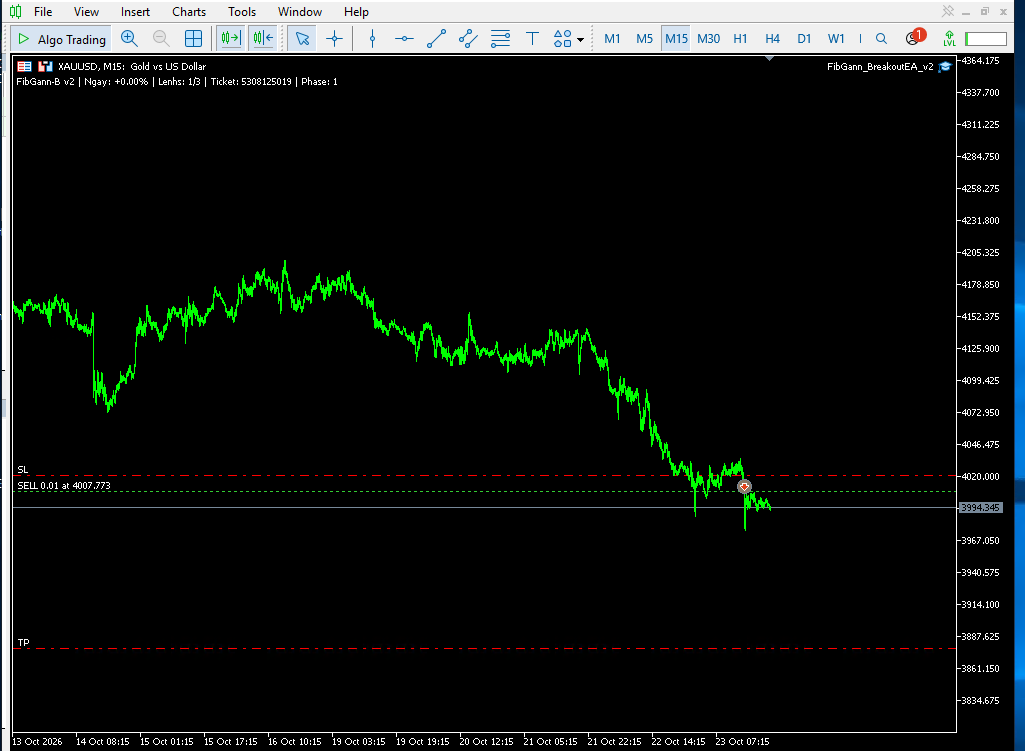
“Ten days of chart, eleven days of waiting. The machine ignored the whole slide from 4,200 — no consolidation, no trade. It waited for a base under 4,025, then sold the break. Stop at 4,020, target at 3,877 — that distance is the entire system.”
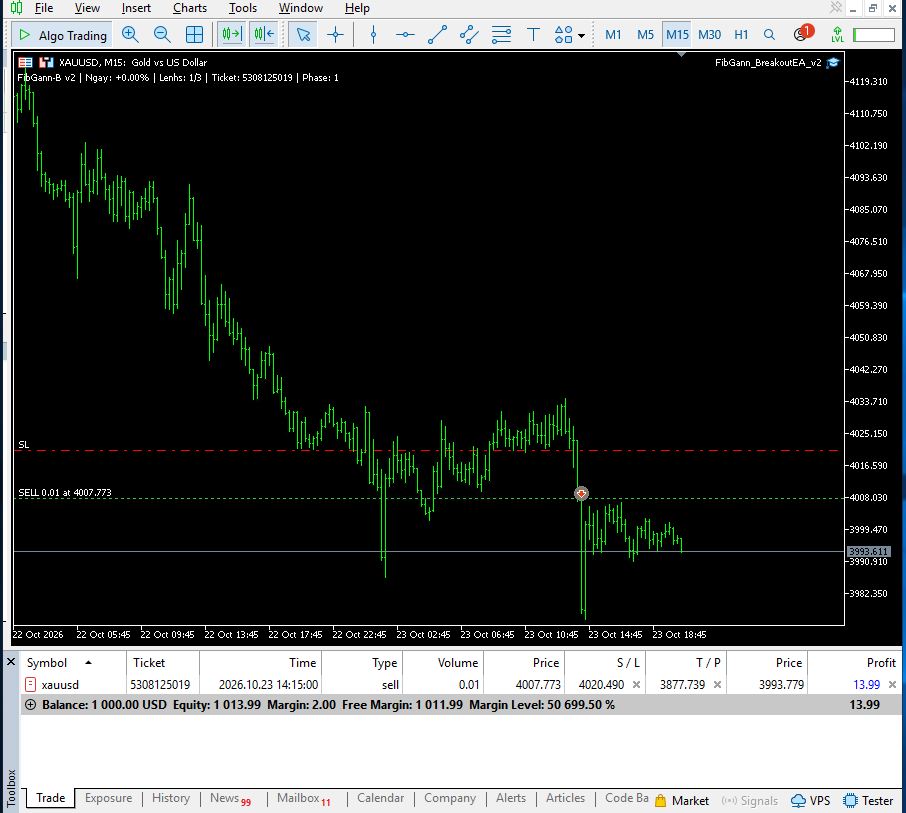
“The first trade, eleven days in — a short on gold, opened by the EA on its demo forward-test account. Still open as I write. Untouched.”
A short, sold at 4,007, with its stop and its target placed by the same rules the backtest used. As I write this, the trade is still open. I don’t know how it ends. Neither does the machine. That is the point.
My only job was the hardest one: watch it happen, and keep my hands off. Silence was never a verdict — and one open trade isn’t one either.
Why it was the hardest
The website cost $2. The workflow cost $0. This one cost me something no ledger shows: every morning I open the terminal and fight the urge to improve what is already running. An engineer who cannot leave a finished structure alone is an engineer who will eventually weaken it.
So the rule stands. The EA runs. I watch. We both do our jobs.
The next machine I built does the opposite of this one: it waits for a human finger before it moves, and on October 26 I will explain why.
Your turn — I read every comment
1. Have you ever had to leave something you built completely alone — and how long did you last?
2. When a system is quiet, do you trust the plan or the itch to change it?
3. What is the one rule in your work you would never break, even when breaking it feels smart?
The best questions become material for the next parts.
One light tap on Share from you is how this travels. The updates, the tools, this whole series — they move one tap at a time, until they reach the person who needs them. You may already know who that is.
Next: I Publish in English. It’s Not My Language.
Follow the whole story on the Built at 60 series page.
Leave a Reply